
01
Defined governed templates.
Cardinality rules. Required fields. Allowed relationships. Templates encode what a valid architecture looks like in your organization.

See it. Fix it.
Govern it.
Your ServiceNow data has problems you cannot see. Blueprints makes them visible, fixable, and governable.
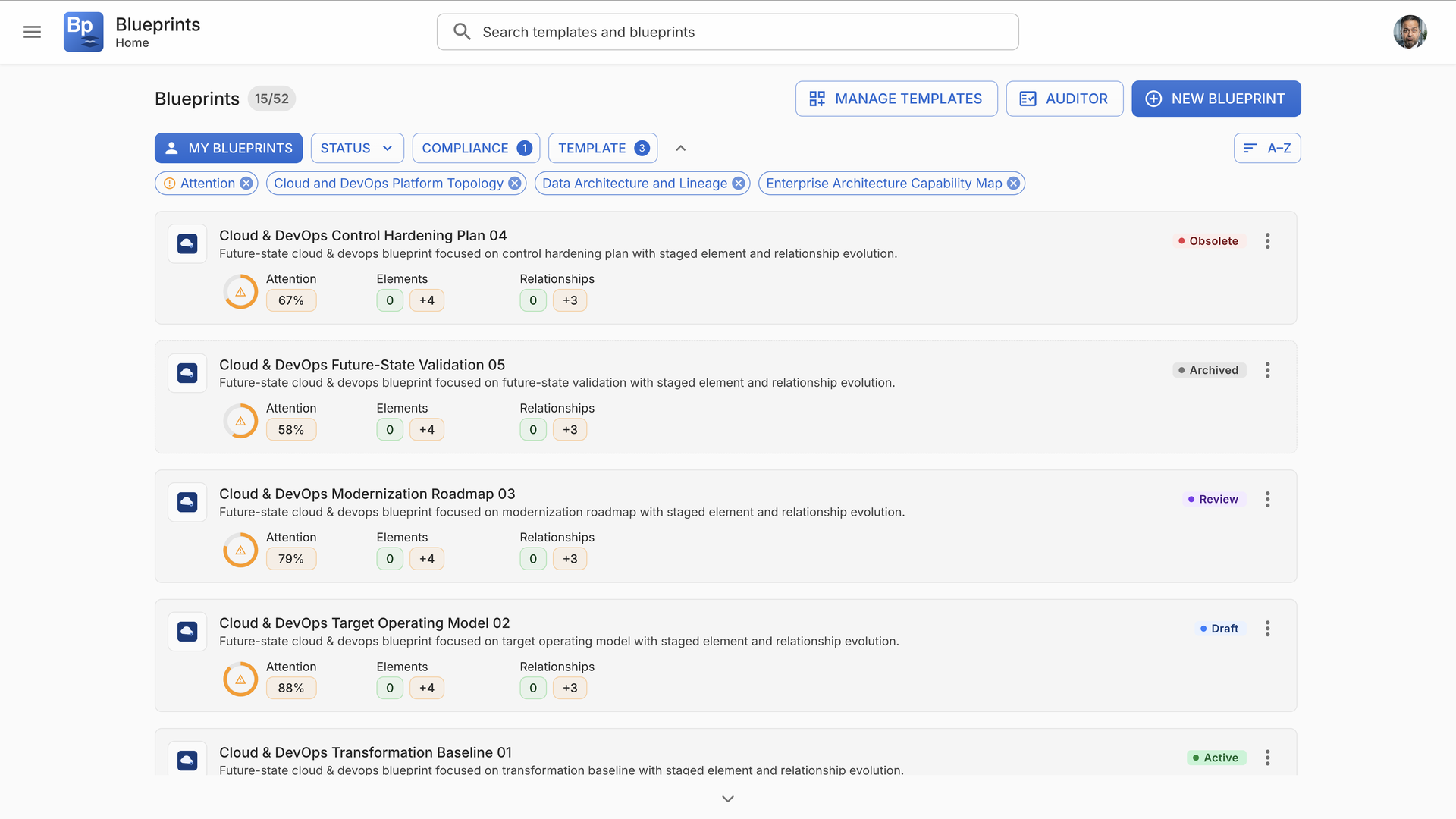
Blueprints makes your ServiceNow data visible, continously auditable, and provably compliant.
"Every week without structural visibility costs more than the solution itself. That cost started accruing before you read this sentence."
Define rules for tables, elements, relationships, and cardinality (min/max). Enforced by design.
Pull live ServiceNow data. Relationships auto-resolved. Gaps visible instantly.
Live compliance per blueprint. Relationships and elements scored in real time.
Run any data against a template. Surface all non-compliant elements and relationships in minutes.
Stage, validate, and commit changes through governed workflows. Fully IRE-aligned.
Not limited to CMDB/CSDM. Works across all ServiceNow tables.
Role-based control. Full audit trail. Aligned with ServiceNow ACLs.
Tutorials
Describe what this product slide shows.
Compliance Check
Describe what this product slide shows.
Auditor
Describe what this product slide shows.
Template Editor
See your Blueprints at a glance, filter, share, audit and create new ones.
Blueprints Editor
Describe what this product slide shows.
Settings
Describe what this product slide shows.
THE PROBLEM
Right now, someone is making a decision on data that isn't correct.
Relationships that should exist do not. Records that should be complete are not. Deployment standards that should be enforced are not written down anywhere.
You have tried to fix this before. You have assembled landscape views manually, pulling from four or more systems that do not agree. It took weeks. By the time the view was done, it was already outdated.
WHAT BLUEPRINTS DOES
01
02
03
What customers actually said.
“We know what our integrations should look like. We've documented the standards for how systems connect to the pay ledger, how they interface with corporate information management. But every project that touches those systems does it differently. We only find out at review. By then it's too late to change direction.
The problem wasn't missing standards. The standards existed. They just lived in documents no one checked against.
We opened Blueprints. Loaded a governed template defining exactly what a compliant integration to the pay ledger looks like. Cardinality rules. Required relationships. Required fields. All of it encoded, not documented.
He went quiet for a moment.
This is the difference between a standard that guides and a standard that governs.
— the Enterprise Architect
That's the shift. Architecture stops being a reactive review after the project is done. It becomes a proactive, measurable baseline every project is held to before anything goes live.
The enterprise doesn't drift. It aligns.
Blueprints turns your best architectural thinking into something the whole enterprise actually builds against.
“I can define the meta model. I can communicate it. I can train people on it. But I have no way of knowing whether my EA teams are actually applying it when they go off to design a solution.
So governance became a feeling. Alignment became an assumption. And every review board meeting started with the same uncomfortable question: how consistent is any of this, really?
We opened Blueprints. Loaded a governed template encoding exactly what a compliant solution design looks like against the meta model. He watched the compliance scores appear across his existing architectures. Green, amber, red. No interpretation required.
That's the reactive view I didn't know I could have.
Then we flipped it. Same template. But now facing forward. Handed to an architect at the start of a new solution. The meta model wasn't a document to reference. It was a structured guide telling them what to complete before they could call it done.
He leaned back. "That's the proactive side. Both problems. Same template."
— the Head of EA
That's the shift. The meta model stops being guidance you hope people follow. It becomes the structure every solution is built inside from day one.
Blueprints makes your EA standards something teams work against, not just work around.
WHO it serves
EA Director
Know every gap, every orphan, every non-compliant element — before the audit does.
CMDB Manager
Stop running quarterly audits. Start running continuous governance.
Transformation Lead
Show leadership the target state on the same canvas as today. Get alignment in one meeting.
Next Step
The gap between your data and your decisions closes the moment you start blueprinting.